
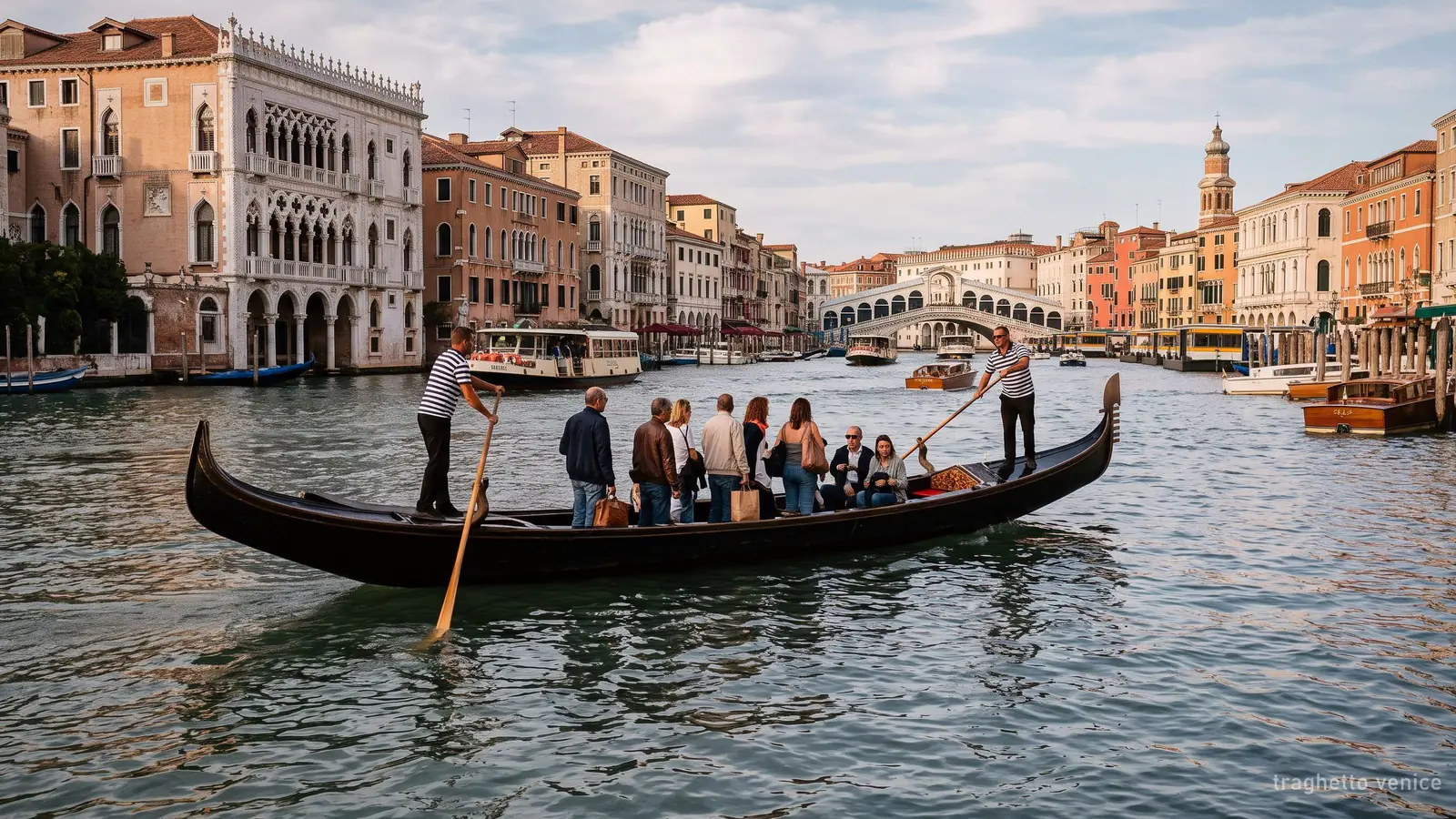
What is a traghetto in Venice?
Updated October 27, 2026
Quick answer
A traghetto in Venice is a gondola used as a ferry across the Grand Canal, rowed by two oarsmen. Visitors pay €2 a crossing and residents €0.70. The trip takes a few minutes, passengers traditionally stand, and it is transport, not a sightseeing ride.
Traghetto means ferry in Italian. Only four bridges cross the Grand Canal, so Venetians have long crossed it in gondolas at set points between them. Fewer crossings run than in the past: a Wikipedia photo caption notes that only three traghetti were left by 2017, and which crossings run, and when, still changes.
Traghetto vs gondola: what is the difference?
Both are gondolas. The difference is the job they do.
- Price — Traghetto: €2 a crossing for visitors. Gondola ride: €90 for 30 minutes by day, per boat.
- Route — Traghetto: straight across the Grand Canal. Gondola ride: a loop through the canals you agree with the gondolier.
- Time — Traghetto: a few minutes. Gondola ride: 30 minutes by day, 35 in the evening.
- Crew — Traghetto: two oarsmen. Gondola ride: one gondolier.
- Passengers — Traghetto: shared with strangers and locals, traditionally standing. Gondola ride: your group only, seated, up to five people.
Where to find a traghetto in Venice
The best-known crossing is at San Tomà, roughly halfway between the Rialto and Accademia bridges. It has become so popular since it appeared in online map directions that, according to Euronews, a queue now stretches along the canal-side pavement. Other crossings exist, but their number and hours change, so we do not list them here. Ask locally on the day which crossings are running. Our Grand Canal routes guide shows where the canal runs.
Is the traghetto cash only?
We could not confirm from an official source whether traghetto crossings accept cards. The fare is €2 for visitors, so the simple answer is to carry a €2 coin and avoid the question. Have it ready as you board. For gondola rides, see whether Venice gondolas are cash only.
Traghetto etiquette: a ferry for locals first
Traghetti are public transport for Venetians, and some residents are unhappy at the queues of visitors using them as a cheap ride. Euronews reported that a local councillor suggested taking the stops off online maps, and that the head traghetto gondolier wants visitors to use the ferry when they need to cross, not as a stand-in for a gondola tour. So use it the way locals do: to get across. Step on and off quickly, keep your bags small, and follow the oarsmen's lead on standing or sitting. If you want time on the water, a gondola ride or a water bus is the better choice; see gondola, water taxi or vaporetto.
Is the traghetto worth it instead of a gondola ride?
As a shortcut, yes. A crossing saves a walk to the nearest of the four bridges over the Grand Canal, and it costs €2. As a replacement for a gondola ride, not really. You are on the water for minutes, you share the boat with locals and other visitors, and you go straight across rather than through the quiet side canals. Think of it as a taste of the gondola and a piece of everyday Venice, then decide whether you want the full 30-minute ride. For groups of three to five, the private ride at €90 by day works out at €18 to €30 each; see how many people fit in a gondola.
Frequently asked questions
How much is a traghetto in Venice?
€2 a crossing for visitors and €0.70 for residents, according to Euronews in August 2025.
What does traghetto mean?
It means ferry in Italian. In Venice it refers to the gondolas that ferry people across the Grand Canal.
Is a traghetto the same as a gondola ride?
No. It is a short crossing of a few minutes, straight across the Grand Canal, shared and usually standing. A gondola ride is a private 30-minute tour for €90 by day.
Do you have to stand on a traghetto?
Passengers traditionally stand for the crossing. Follow the oarsmen's lead and hold on as you board.
Is there a traghetto map?
Crossings and their hours change, so no fixed map stays accurate for long. San Tomà, between the Rialto and Accademia bridges, is the best-known stop.
Sources