
informational 5 min read
Rialto Bridge Venice 2026: History, Views and Gondolas
Updated October 27, 2026
TL;DR: The Rialto Bridge is the oldest of the four bridges across Venice’s Grand Canal and links the San Marco and San Polo districts. The stone bridge was built in 1588–1591 to a design by Antonio da Ponte, with a single arch spanning 31.80 m and rising 7.32 m. It replaced wooden bridges that burned in 1310 and collapsed in 1444 and 1524. It is free to walk across, lined with shops, and sits next to the Rialto market. Gondolas pass beneath it; a ride costs €90 for 30 minutes by day or €110 for 35 minutes from 19:00, per boat.
Why is the Rialto Bridge so famous?
The Rialto Bridge is famous for three reasons: its age, its shape and where it stands.
Age. For centuries it was the only way to cross the Grand Canal on foot. The other three bridges, the Accademia, the Scalzi and the Costituzione, came in the 19th century and later. The Costituzione opened only in 2008.
Shape. It is one stone arch, not several. That was a bold choice. In 1551, designs by Jacopo Sansovino, Andrea Palladio and Vignola were turned down because they used more than one arch. Michelangelo was also considered. The job went to Antonio da Ponte. His bridge has two ramps that rise to a central portico, with covered rows of shops on each side. The architect Vincenzo Scamozzi predicted it would fall into ruin. Instead, it became one of the best-known bridges in the world.
Place. The Rialto area has been the business heart of Venice for centuries. The city’s market moved there in 1097. Banks, warehouses and shops followed. The name even reached literature: Robert Browning called it “Shylock’s bridge”, a nod to The Merchant of Venice.
What happened to the Rialto Bridge? A short history
The story of the Rialto Bridge is a story of rebuilding. These facts come from Wikipedia’s Rialto Bridge article:
| Date | Event |
|---|---|
| Late 12th century | A pontoon bridge, the Ponte della Moneta, built by Nicolò Barattieri (Wikipedia gives both 1173 and 1181) |
| 1255 | A wooden bridge replaces it, with a central section that lifts for tall ships |
| 1310 | Partly burned in the revolt led by Bajamonte Tiepolo |
| First half of the 15th century | Two rows of shops added; their rents pay for upkeep |
| 1444 | Collapses under a crowd rushing to watch a wedding |
| 1503 | A stone bridge is first proposed |
| 1524 | The wooden bridge collapses again |
| 1588–1591 | The stone bridge by Antonio da Ponte is built |
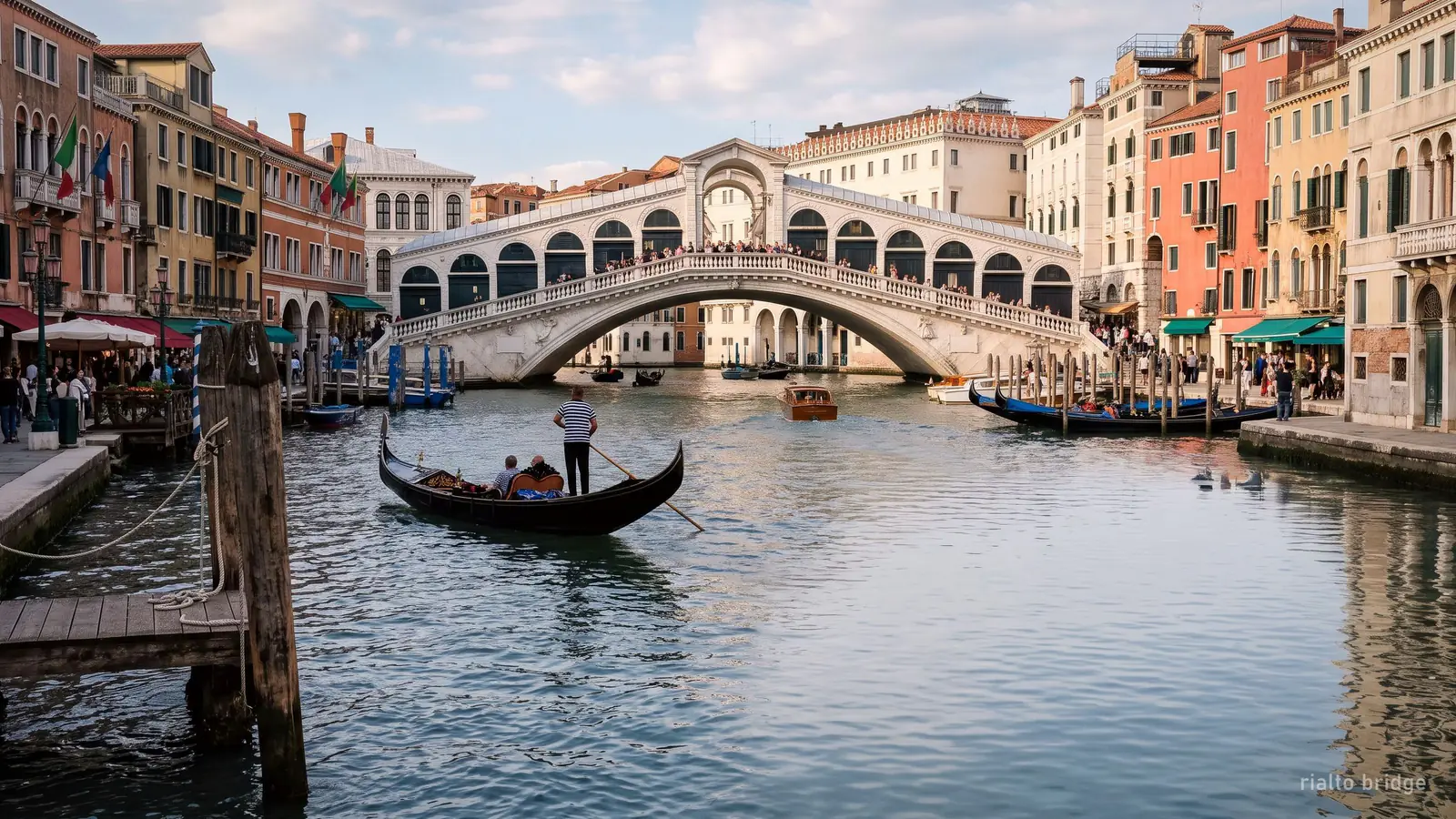
The stone bridge is 22.90 m wide. Its arch spans 31.80 m and rises 7.32 m above the water, high enough for boats to pass.
What is the meaning of Rialto?
The name comes from Rivoaltus, “high bank”. By the ninth century this was the name of a small district in the islands where Venice grew. The canal that became the Grand Canal ran through it. Later, “Rialto” came to mean only the area on one bank, now in the San Polo district.
Today the Rialto is still a market quarter. Next to the bridge you will find the produce market (the Erberia) and the fish market on the Campo della Pescheria. Find them on Google Maps.
Can you walk across the Rialto Bridge in Venice?
Yes. The Rialto Bridge is a public footbridge and free to cross at any time. It is one of the main walking routes between St Mark’s Square and the San Polo side.
What to expect:
- Steps. Each side climbs a ramp of steps to the top. That makes it hard going with a stroller, a wheelchair or heavy luggage.
- Shops. The covered ramps are lined with small shops, as they have been since the 15th century.
- Views. The top of the bridge looks along the Grand Canal in both directions. It is a classic spot for photos of gondolas and water buses below.
A guided walk can add context. A walking tour with a gondola ride option stops at the Rialto Bridge and lets you add a ride, from about $30 a person at our 27 October 2026 check.
Rialto Bridge gondola rides: seeing it from the water
From the water, the Rialto Bridge is even more striking. Gondolas, water buses and water taxis all pass under its arch on the Grand Canal.
Our guide to the best gondola stations in Venice shows where to hire a boat. The fare is the same city fare as anywhere else: €90 (about $100) for 30 minutes from 09:00 to 19:00, and €110 (about $123) for 35 minutes from 19:00, per gondola. Routes differ by station, so if passing under the Rialto matters to you, agree on it with the gondolier before you board. See the full fare details on our gondola ride price page, or compare gondola rides you can book ahead.
Want to stay close? See hotels near the Rialto Bridge. For more sights nearby, read things to do in Venice.
Frequently asked questions
When was the Rialto Bridge built?
The stone bridge you see today was built between 1588 and 1591 to a design by Antonio da Ponte. Wooden bridges stood on the spot before it, and a pontoon bridge before them in the late 12th century.
Is the Rialto Bridge free to cross?
Yes. It is a public pedestrian bridge. You walk up ramps of steps on either side to a central portico, with rows of shops along the way.
What does Rialto mean?
Rialto comes from Rivoaltus, meaning "high bank", the name of a small district in the islands where Venice grew. The name later came to mean the area on one bank of the Grand Canal, in the San Polo district.
How many bridges cross the Grand Canal?
Four: the Rialto, the Accademia, the Scalzi and the Costituzione, which opened in 2008. The Rialto was the only crossing until the 19th century.
Can you take a gondola under the Rialto Bridge?
Gondolas and other boats pass under it on the Grand Canal. Whether your ride goes there depends on the station you start from, so agree on the route with the gondolier before you board.
Sources