
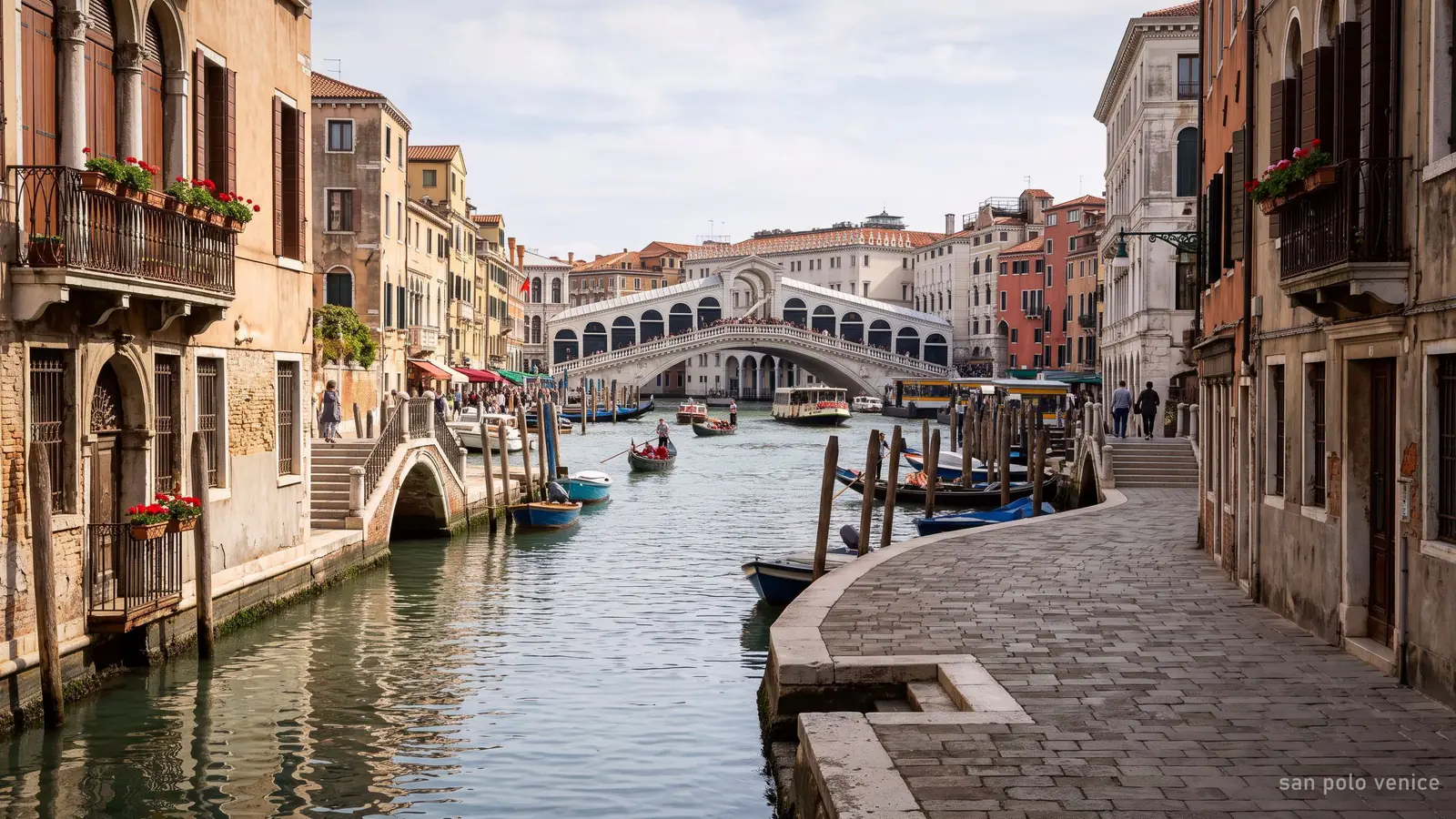
San Polo, Venice: 2026 Guide to the Rialto District
Updated October 27, 2026
San Polo is the smallest and most central of Venice's six sestieri, a district of just 35 hectares (86 acres) on the west bank of the Grand Canal. It is also one of the oldest parts of the city, settled before the 9th century. San Polo holds the Rialto, the city's main market since 1097, and the Rialto Bridge that links it to San Marco. Its western half is a district of great churches, from the Frari to the Scuola Grande di San Rocco. For gondolas, San Polo has the San Tomà station, one of the ten official stations, with both full rides and a €2 traghetto crossing of the Grand Canal.
What is San Polo in Venice?
San Polo is named after the Church of San Polo. Together with San Marco, it formed part of the Realtine Islands, the first core of the city. The district has been the site of Venice's main market since 1097, and it has been tied to the eastern bank of the Grand Canal by the Rialto Bridge since the 13th century. Today the district has two moods. The eastern part, often just called the Rialto, is a tight knot of market stalls, palaces and small houses, busy from morning to evening. The western part, around Campo San Polo and the Frari, is known for its churches and is noticeably calmer.
What to see in San Polo
The district is small, so its main sights sit close together on either side of the Rialto.
- Rialto Bridge — The oldest of the four bridges over the Grand Canal. It began as a pontoon bridge in 1173 and has been rebuilt several times since.
- San Giacomo di Rialto — By legend the oldest church in Venice. Its front forms the eastern side of the Rialto square, and it survived the great fire of 1514.
- Campo San Polo — The largest campo in Venice, and the second-largest public square in the city after Piazza San Marco.
- Santa Maria Gloriosa dei Frari — One of the largest churches in Venice, a minor basilica dedicated to the Assumption of Mary.
- Scuola Grande di San Rocco — A confraternity building famous for its Tintoretto paintings, widely held to include some of his finest work.
- House of Goldoni — The birthplace of the playwright Carlo Goldoni, one of the district's listed attractions.
Gondola rides from San Polo: San Tomà and the Rialto
San Tomà is one of the ten official gondola stations listed by the City of Venice. It sits at the end of Calle del Traghetto o Ca' Garzon, on the Grand Canal halfway between the Rialto and the Accademia bridge. Its Google Maps profile is rated 4.5 from 565 reviews (October 2026), one of the higher scores among the city's busy stations. From here you can take a full ride at the official fare (€90 for 30 minutes by day, €110 for 35 minutes after 19:00, per boat) or cross the Grand Canal standing up on the traghetto for €2. Around the Rialto, several more boarding points appear on Google Maps: one on Calle del Perdon (rated 5.0 from 310 reviews) and one at the Rio Terà San Aponal bridge (4.6 from 43). A ride from the Rialto side usually takes in the busiest bend of the Grand Canal and the bridge itself, seen from the water. On the opposite bank, the official Carbon station sits on the Riva del Carbon. If you would rather fix a time and price in advance, compare private gondola rides. Compare every option in where to get a gondola in Venice.
How to get to San Polo
Vaporetto Line 1 has three stops on the San Polo bank of the Grand Canal: Rialto Mercato for the market, San Silvestro just south of the bridge, and San Tomà for the Frari and the gondola station. On foot from Santa Lucia station, you cross the Grand Canal and walk through Santa Croce, the district between the station and San Polo. From St Marks Square, cross the Rialto Bridge and you are in the district. See the Rialto Bridge guide for the bridge itself.
Who should stay in San Polo?
San Polo suits travellers who want to be central without staying in San Marco. The Rialto Bridge puts St Marks Square within easy walking distance, and the market gives the district its own daily life. The trade-off is that the streets around the bridge are among the most crowded in Venice by day. The western side near the Frari and Campo San Polo is quieter. For hotels near the bridge, see hotels near the Rialto Bridge, and for a wider plan, things to do in Venice.
City of Venice: gondola service and stationsWikipedia: San Polo
Frequently asked questions
Is San Polo a good area to stay in Venice?
Yes, if you want a central base. It is the smallest and most central sestiere, a short walk over the Rialto Bridge from San Marco. The area right by the bridge is crowded by day; the western side is calmer.
Where can I get a gondola in San Polo?
The official San Tomà station on the Grand Canal is the main one. Boarding points near the Rialto Bridge, such as Calle del Perdon, also appear on Google Maps. The official fare is the same everywhere.
Can I cross the Grand Canal by gondola from San Polo?
Yes. The San Tomà traghetto crosses the Grand Canal by gondola for €2 for tourists. Hours change, so check on the day.
Which vaporetto stops serve San Polo?
Rialto Mercato, San Silvestro and San Tomà, all on Line 1 along the Grand Canal.
How big is San Polo?
About 35 hectares (86 acres), which makes it the smallest of the six sestieri of Venice.
Sources