
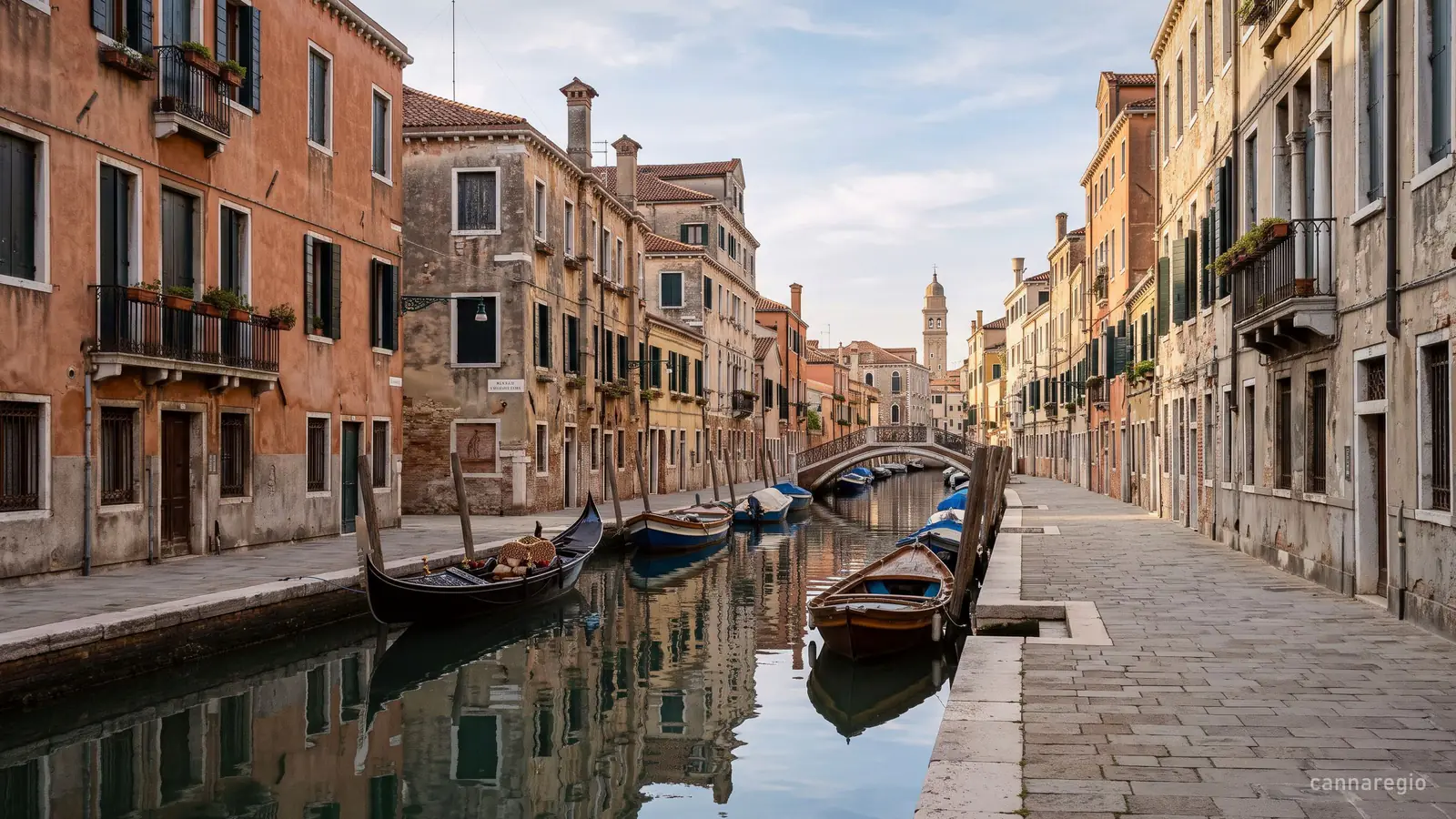
Cannaregio, Venice: 2026 Guide to the Quiet North
Updated October 27, 2026
Cannaregio is the northernmost of Venice's six sestieri and the one where most Venetians still live. It is the second-largest district by area and the largest by population, with 13,169 residents in 2007. The strip along the Grand Canal from the train station to the Rialto Bridge is busy, but the rest of Cannaregio is residential and calm, with morning markets, neighbourhood shops and long canal-side walks. For a gondola ride it offers two things the centre does not: the Santa Sofia traghetto, the cheapest gondola crossing of the Grand Canal at €2, and quiet canals where a ride feels far from the crowds around St Marks Square.
What is Cannaregio known for?
The district takes its name from the Cannaregio Canal, the main water route into Venice until the railway bridge to the mainland was built in 1846. Building began in the 11th century, when the land was drained and parallel canals were dug. Grand palaces went up along the Grand Canal, but most of Cannaregio grew as working-class housing and workshops. In 1516 the Venetian Republic forced the city's Jews to live in the Ghetto here, behind gates that were locked from sunset to dawn. The English word ghetto comes from this place. The restrictions lasted until Napoleon conquered Venice in 1797 and removed the gates. In the 19th century engineers cut the Strada Nuova, a wide street through the district, and built the rail and road bridges to Mestre.
What to see in Cannaregio
The sights are spread out, which is part of the appeal: you walk between them along canals rather than through crowds.
- Venetian Ghetto — Set up on 29 March 1516 by decree of Doge Leonardo Loredan and the Senate. The word ghetto entered English from here.
- Ca' d'Oro — The House of Gold on the Grand Canal, named for the gilt that once covered its facade. Since 1927 it has been the Galleria Giorgio Franchetti museum.
- Madonna dell'Orto — Tintoretto's parish church. It holds several of his paintings and his tomb.
- Cannaregio Canal — The wide canal that was once the main entrance to Venice, lined with palaces such as Palazzo Labia. Its Google Maps profile is rated 4.7 from 487 reviews.
- Santa Lucia station — The city's railway station sits on the district's western edge, so Cannaregio is the first district most rail travellers walk into.
Gondola rides and traghetti in Cannaregio
Two of the ten official gondola stations listed by the City of Venice are in Cannaregio: Santa Sofia and San Marcuola. The fare is the same as anywhere else in the city: €90 for 30 minutes by day and €110 for 35 minutes after 19:00, for the whole boat. Santa Sofia is also a traghetto point. A traghetto is a plain gondola rowed by two oarsmen that ferries passengers across the Grand Canal; passengers traditionally stand. The crossing from Campo Santa Sofia runs to the Rialto market side. Tourists pay €2 a crossing and residents €0.70. Its Google Maps profile is rated 4.3 from 520 reviews (October 2026). Traghetto hours change, so check on the day. Read what a traghetto is before you go. For a full ride, the canals north of the Strada Nuova are among the quietest in the city. A Google Maps listing on the Fondamenta San Felice (rated 4.2 from 55 reviews) shows gondolas boarding there. A ride through these back canals trades the palaces of the Grand Canal for washing lines, small bridges and very few other boats. Compare routes in the best gondola routes in Venice and stations in where to get a gondola.
How to get to Cannaregio
If you arrive by train you are already there: Santa Lucia station opens onto the district. Vaporetto Line 1 serves the Grand Canal side with stops at Ferrovia, San Marcuola and Ca' d'Oro. The Cannaregio Canal has its own stops at Tre Archi, Crea and Guglie. On the northern shore, Fondamente Nove is the departure point for Line 12 to Murano and Burano, which makes Cannaregio a handy base for a day on the lagoon islands.
Who should stay in Cannaregio?
Cannaregio suits travellers who want quiet evenings, small cafés and a shorter walk from the train station. It also suits repeat visitors who have already seen the Piazza. The trade-off is distance: St Marks Square is on the other side of the city, so plan on a long walk or a vaporetto ride for the main sights. If you have only one day in Venice, San Marco is the more practical base. For the full picture, see things to do in Venice.
City of Venice: gondola service and stationsWikipedia: Cannaregio
Frequently asked questions
Is Cannaregio a good area to stay in Venice?
Yes, if you want a quieter, more residential base close to the train station. It is a long walk or a vaporetto ride from St Marks Square, so it suits longer stays better than a one-day visit.
Can you take a gondola in Cannaregio?
Yes. Santa Sofia and San Marcuola are official gondola stations listed by the City of Venice, and the fare is the same as in San Marco: €90 by day or €110 after 19:00 per boat.
What is the Santa Sofia traghetto?
A gondola ferry that crosses the Grand Canal from Campo Santa Sofia to the Rialto market side. Tourists pay €2 per crossing. Hours change, so check on the day.
Why is it called the Ghetto?
The English word ghetto comes from the Venetian Ghetto in Cannaregio, where the Republic forced Jews to live from 1516 until 1797.
Which vaporetto stops serve Cannaregio?
Ferrovia, San Marcuola and Ca' d'Oro on Line 1 along the Grand Canal; Tre Archi, Crea and Guglie on the Cannaregio Canal; and Fondamente Nove on the northern shore for boats to Murano and Burano.
Sources