
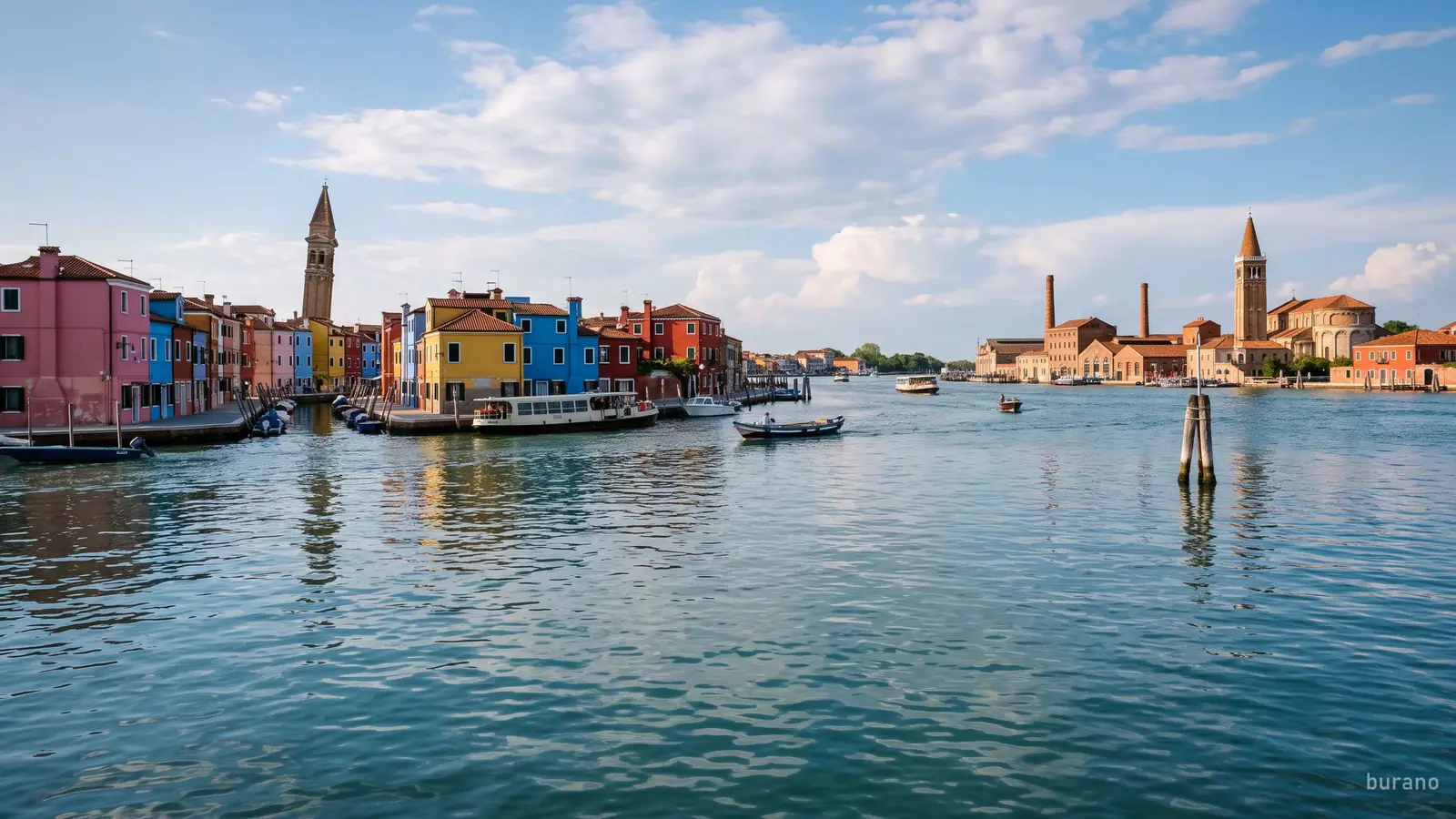
Burano and Murano, Venice: 2026 Lagoon Islands Guide
Updated October 27, 2026
Burano is the island of brightly painted houses and lace in the north of the Venetian Lagoon, 7 kilometres (4 miles) from Venice and about 45 minutes by vaporetto from St Mark's Square. Murano, the island of glass, lies only 1.5 kilometres (1 mile) north of the city, on the way. Most visitors see both in one day, by water bus or on a boat tour. Neither island is a gondola stop: the city's official gondola stations are all in the historic centre, so plan your gondola ride for before or after the trip. This guide covers what to see on each island, how to get there and which tours are worth it.
What is Burano known for?
Burano is famous for its small, brightly painted houses and its lace. The colours follow a set system: an owner who wants to repaint must ask the authorities, who reply with the colours allowed for that lot. About 2,800 people live on the island, at a density of more than 13,000 people per square kilometre, and a bridge links it to the neighbouring island of Mazzorbo. Lacemaking began in the 16th century. The trade declined in the 18th century and revived in 1872, when a school of lacemaking opened. Few people still make lace the traditional way, because it is extremely slow and therefore expensive, so read labels carefully if you are buying.
- Piazza Baldassare Galuppi — The island's only square, named after the composer born here in 1706. It holds the Lace Museum, the town hall and a well made of Istrian stone.
- San Martino — The parish church, with a leaning bell tower and a Crucifixion painted by Giambattista Tiepolo in 1727.
- Mazzorbo — The quiet island across the wooden bridge, known for vineyards and orchards and the 14th-century church of Santa Caterina.
What is Murano known for?
Murano is a group of islands linked by bridges, about 1.5 kilometres across, with just over 5,000 people. In 1291 the Venetian Republic ordered all glassmakers to move their furnaces here, partly for fear of fire in the city's wooden buildings. Murano became Europe's leading glass producer, famous first for beads and mirrors and later for chandeliers. Glassmaking is still the island's main industry, and many furnaces are open to the public.
- Murano Glass Museum — The museum of the history of glass, in the large Palazzo Giustinian.
- Santa Maria e San Donato — A church known for its 12th-century Byzantine mosaic floor and, by legend, the bones of a dragon slain by Saint Donatus.
- San Pietro Martire — A church with artworks by Giovanni Bellini.
How to get to Burano and Murano from Venice
The water bus is the cheap option. Line 12 leaves from Fondamente Nove, on the northern shore of Cannaregio, and calls at Murano on its way to Burano. Lines 9 (Burano to Torcello) and 14 (from San Zaccaria via the Lido and Punta Sabbioni) also serve Burano, and a night service runs. For Murano alone, Murano Colonna is a main stop, served by lines from San Zaccaria and Fondamente Nove. A trip to Burano takes about 45 minutes from St Mark's. If you are starting in the north of the city, Cannaregio puts you closest to Fondamente Nove. Guided tours bundle the transport. In the October 2026 listings, a shared tour of Murano, Burano and Torcello costs about $20 and is rated 3.9 from 2,378 reviews. A guided tour by boat with a glassmaking demonstration costs about $39 and is rated 4.7 from 7,797 reviews, one of the largest review counts among the Venice listings we checked. A fully private boat tour with hotel pickup runs to about $469 per group. Compare them with other ideas in day trips from Venice.
Can you take a gondola ride on Burano or Murano?
Not an official one. All ten gondola stations listed by the City of Venice are in the historic centre, and no gondola stand on either island appeared in our Google Maps search. Burano and Murano have their own canals, but you see them on foot or from the vaporetto. The practical plan is to ride a gondola in the city on the same day: take an early boat to the islands, and come back for a ride from San Marco or the Rialto in the late afternoon, or after 19:00 at the evening fare. The official fare is €90 for 30 minutes from 09:00 to 19:00 and €110 for 35 minutes after 19:00, per boat. Start with where to get a gondola in Venice and things to do in Venice.
Who should visit Burano and Murano?
Burano suits photographers and anyone who wants a slower half-day away from the crowds of San Marco. Murano suits visitors interested in glass, from a furnace demonstration to the museum. Torcello, the sparsely populated island beside Burano, first settled in 452 AD and once home to a cathedral older than St Mark's, suits history lovers. Allow at least half a day for Murano and Burano together, more if you add Torcello. With only one day in Venice, put the main city sights and a gondola ride first.
Wikipedia: BuranoWikipedia: Murano
Frequently asked questions
How far is Burano from Venice?
About 7 kilometres (4 miles), or roughly 45 minutes from St Mark's Square by vaporetto.
Which vaporetto goes to Burano and Murano?
Line 12 from Fondamente Nove calls at Murano and then Burano. Lines 9 and 14 also serve Burano.
Can you take a gondola in Burano?
No official gondola station is on Burano or Murano. Take your gondola ride in the historic centre, where the official fare is €90 by day or €110 after 19:00 per boat.
Why are the houses in Burano so colourful?
The colours follow a set system: owners must ask the authorities before repainting, and are told which colours are allowed for their lot.
Is a Murano and Burano tour worth it?
It saves planning. A guided boat tour with a glassmaking demonstration cost about $39 in October 2026 and is rated 4.7 from 7,797 reviews; the water bus is cheaper if you are happy to plan your own day.
Sources