
informational 5 min read
History of the Venice Gondola: From 1094 to Today
Updated October 27, 2026
TL;DR: The history of the Venice gondola goes back to at least 1094, when the boat is first named. In the 1500s Venice had about 10,000 gondolas of all kinds; by 1878 about 4,000; today about 400, nearly all for visitors. Gondolas are black because Venice’s sumptuary laws banned showy colours. The modern, banana-shaped, asymmetrical gondola took shape in the 19th century, and the city later froze the design. Each one is built from 280 hand-made pieces of eight woods in about two months, in boatyards called squeri such as the Squero di San Trovaso (1600s).
What is the history of gondolas in Venice?
Venice is a city of islands, so boats came before roads. The gondola is first named in a record from 1094, and it has been part of Venetian life since the 11th century, according to Wikipedia’s gondola article. Nobody has ever settled where the word “gondola” comes from.
For most of its history the gondola was everyday transport in a city with no streets for carts. That is why the numbers were once so large. In the 1500s, Venice had about 10,000 gondolas of all kinds. Estimates for the 17th and 18th centuries are still 8,000 to 10,000.
Older gondolas often carried a small cabin called a felze. It kept passengers dry in winter and hidden from curious eyes. Felzi lasted until the early 20th century. In summer, light awnings called tendalin gave shade until about the mid-1950s.
The gondola slowly lost its everyday role. By 1878 the count had fallen to about 4,000. Today about 400 gondolas remain in service, and nearly all of them carry visitors at fares set by the City of Venice: €90 for 30 minutes by day and €110 for 35 minutes from 19:00, per boat. The gondola also survives in the traghetto, a two-oar ferry across the Grand Canal, and in regattas such as the historical regatta on the first Sunday of September.
Why are gondolas black?
Gondolas are black because of Venice’s sumptuary laws. These laws limited how much wealth people could show off in public, from clothes to boats. A plain black boat shows off no one’s wealth. Wikipedia records the rule but gives no date for it, so we do not give one either.
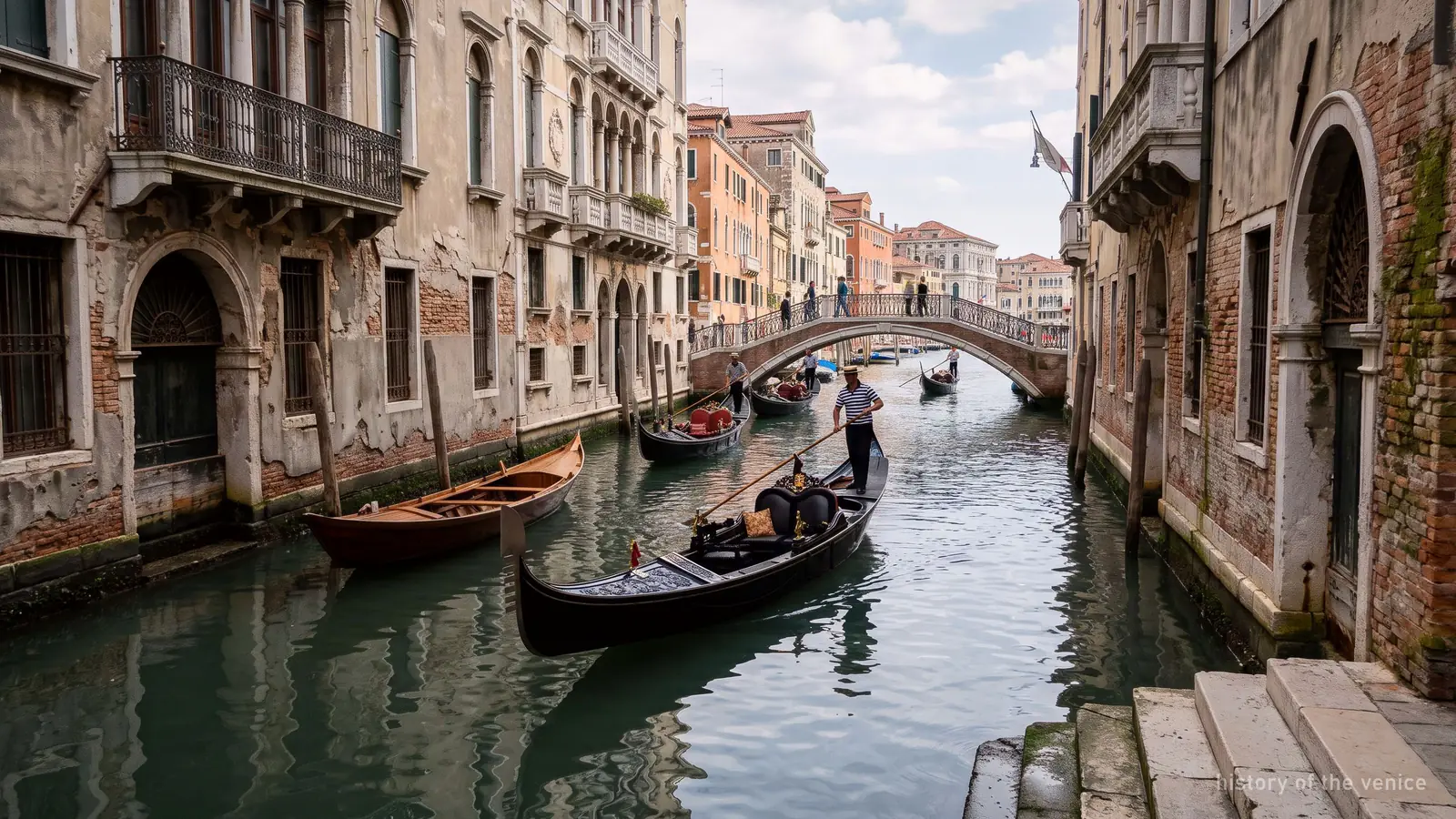
The black stuck. Today it is simply what a gondola looks like, and the ban on flashy boats became part of the city’s style.
How are gondolas made?
Gondolas are made by hand in a boatyard called a squero. The numbers, from Wikipedia:
- 280 hand-made pieces
- Eight kinds of wood: lime, oak, mahogany, walnut, cherry, fir, larch and elm
- About two months to build
- About €38,000 for a new gondola in 2013
- Up to 11 m long, about 1.6 m wide and about 350 kg
The key design trick is the shape. A gondola is asymmetrical along its length: one side curves more than the other. This lean pushes against the gondolier’s single oar, so the boat goes straight. The modern banana-like form was developed in the 19th century by the boatbuilder Tramontin. In the mid-20th century the city banned further changes to the design.
Two pieces of metal and wood finish the boat. The ferro, the iron at the prow, is decoration and also balances the gondolier’s weight at the stern. The forcola is the carved oarlock that gives the oar several positions for rowing, turning and stopping. The popular story that the ferro’s six teeth stand for Venice’s six districts is, Wikipedia says, an urban legend: old photos show four or five teeth.
The Squero di San Trovaso
If you want to see where gondolas are made, go to the Squero di San Trovaso. It stands on the Rio San Trovaso in Dorsoduro and dates from the 1600s. Its wooden building looks like a mountain house, not a Venetian palace. The Italian Wikipedia links that look to the many master boatbuilders who came from the Cadore mountains.
It is one of the very few squeri still at work. Today it builds and repairs only gondolas. It is a working yard, so you look across the canal rather than walk in. Find it on Google Maps.
How many gondolas are in Venice today?
About 400, with about 400 licensed gondoliers to row them. Licences are limited, and each gondolier trains for about 400 hours and passes an exam before rowing visitors. Read more in our Venice gondoliers guide, and see the boat itself in the Venice gondola guide.
The best way to feel this history is from the water. Compare gondola rides to find a shared seat or a private boat, or check what a ride costs at a gondola station.
Frequently asked questions
How old is the Venice gondola?
The gondola has been in Venice since at least the 11th century. Its first known mention by name dates from 1094.
Why are gondolas black?
Venice's sumptuary laws, which limited showy displays of wealth, required gondolas to be painted black. The colour became the tradition and has stayed.
How many gondolas are there in Venice?
About 400 are in service today, almost all hired by visitors. In the 1500s there were about 10,000 gondolas of all kinds, and about 4,000 in 1878.
How are gondolas made?
In a boatyard called a squero, from 280 hand-made pieces of eight woods: lime, oak, mahogany, walnut, cherry, fir, larch and elm. A gondola takes about two months to build and cost about €38,000 in 2013.
Where can you see gondolas being built?
The Squero di San Trovaso, on the Rio San Trovaso in Dorsoduro, dates from the 1600s and still builds and repairs gondolas. It is one of very few squeri still working.
Sources