
Dorsoduro, Venice: 2026 Guide to Art, Squeri and Zattere
Updated October 27, 2026
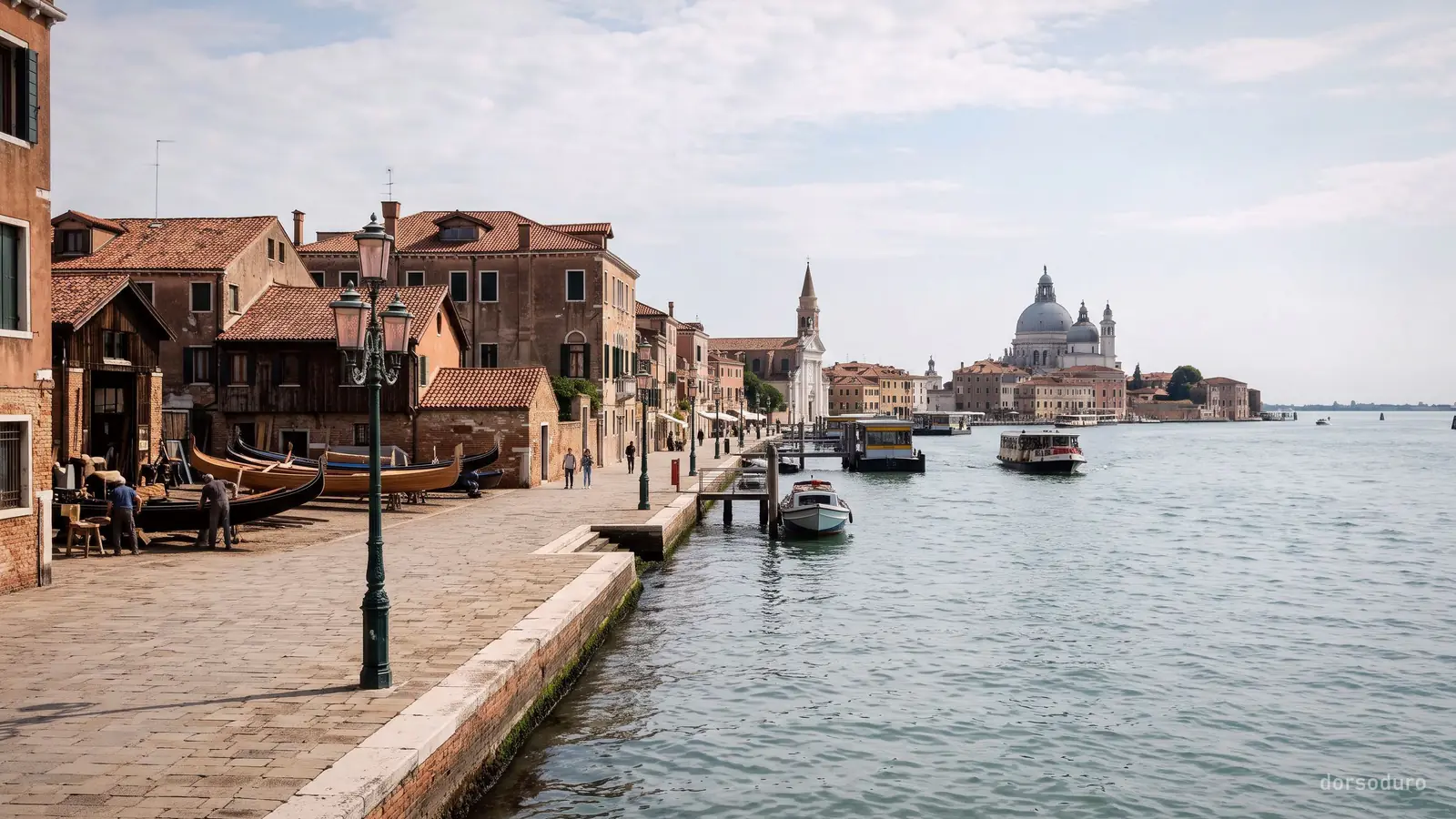
Dorsoduro is the southern district of Venice, stretching from the Grand Canal in the north to the Giudecca Canal in the south. Its name means hard back or hard ridge, after the firmer ground it was built on compared with the marshier parts of the lagoon. Dorsoduro is Venice's art district: the Gallerie dell'Accademia, the Peggy Guggenheim Collection and Ca' Rezzonico all sit here, and the dome of Santa Maria della Salute closes the view at the mouth of the Grand Canal. For gondola lovers it has something no other district can match: the Squero di San Trovaso, a working yard where gondolas are built and repaired by hand.
What is Dorsoduro known for?
The first buildings went up along the Giudecca Canal from the 6th century, and by the 11th century settlement had spread north to the Grand Canal. In the 19th century the Accademia gallery opened here and the Accademia bridge linked the district to San Marco. Dorsoduro became an expensive area, popular with foreign residents, while its western end and Giudecca turned industrial. Today the district is known for three things: its museums, its long southern waterfront along the Zattere, and the Punta della Dogana, the triangle of land where the Grand Canal meets the Giudecca Canal. Giudecca island is sometimes counted as part of Dorsoduro; it has its own guide.
What to see in Dorsoduro
The main sights line the Grand Canal between the Accademia bridge and the Salute, so you can see them in one walk.
- Gallerie dell'Accademia — Venice's gallery of pre-19th-century art, in the former Scuola Grande, church and convent of Santa Maria della Carità. It owns Leonardo's Vitruvian Man, shown only for a few weeks every six years.
- Peggy Guggenheim Collection — Modern art in the Palazzo Venier dei Leoni on the Grand Canal, Peggy Guggenheim's home for three decades. Open year-round since 1980.
- Santa Maria della Salute — The domed church vowed by the Republic after the plague of 1630, designed by Baldassare Longhena. Building began in 1631.
- Punta della Dogana — The old sea customs house at the tip of the district, now an art museum, with open views over the San Marco basin.
- Ca' Rezzonico — A Longhena palace on the Grand Canal, now the city museum of 18th-century Venice, with paintings by Guardi and Tiepolo.
- San Trovaso — A church dating back to at least 1028, rebuilt by 1584, with works by Jacopo and Domenico Tintoretto. The gondola yard stands beside it.
Gondolas in Dorsoduro: the San Trovaso squero and the Dogana traghetto
The Squero di San Trovaso is a boatyard (squero) on the Rio di San Trovaso, listed on Google Maps as a boat builder and rated 4.6 from 473 reviews (October 2026). It is a working yard, not a museum, so most visitors see it from the fondamenta across the canal; the one visit inside listed online is a private tour, about $331. A gondola is built from 280 hand-made pieces in eight kinds of wood and takes about two months to finish; yards like this one are where that happens. Read more in the history of the Venice gondola. For a ride, Dorsoduro has fewer stations than San Marco. A traghetto point on the Fondamenta della Salute, by the Dogana, is rated 4.4 from 103 reviews on Google Maps, and a small station near the Accademia (Gondole Accademia, 4.5 from 13 reviews) also appears there. Rides from the San Marco stations often cross the Grand Canal to pass the Dorsoduro bank, where the Guggenheim and the Salute face the water. One listed private ride, rated 5.0 from only 3 reviews, combines the Grand Canal with Dorsoduro's inner canals and passes the gondola yards. The official fare does not change by district: €90 for 30 minutes by day and €110 for 35 minutes after 19:00, per boat. Compare routes in the best gondola routes in Venice.
How to get to Dorsoduro
Vaporetto Line 1 stops on the Dorsoduro bank of the Grand Canal at Ca' Rezzonico, Accademia and Salute. On the southern side, Line 2 calls at Zattere and San Basilio along the Giudecca Canal. On foot from St Marks Square, cross the Accademia bridge; from the Rialto, walk south through San Polo.
Who should stay in Dorsoduro?
Dorsoduro suits art lovers and travellers who want a calmer base that is still central. The Accademia bridge puts San Marco a short walk away, and the Zattere waterfront faces south over the Giudecca Canal, a long, open promenade for an evening walk. The trade-off is fewer vaporetto lines than on the San Marco side. For more ideas, see things to do in Venice and the most romantic things to do in Venice.
City of Venice: gondola service and stationsWikipedia: Dorsoduro
Frequently asked questions
What does Dorsoduro mean?
Hard back or hard ridge in Italian, after the firmer ground the district stands on compared with the marshier parts of the lagoon.
Can you see gondolas being built in Venice?
You can see the Squero di San Trovaso in Dorsoduro, a working boatyard where gondolas are built and repaired. It is a workplace, not a museum: most people see it from across the Rio di San Trovaso.
Can you take a gondola from Dorsoduro?
Yes. A traghetto point by the Salute and a small station near the Accademia appear on Google Maps, and rides from the San Marco stations often pass this bank. The official fare is the same in every district.
Which vaporetto stops serve Dorsoduro?
Ca' Rezzonico, Accademia and Salute on Line 1 along the Grand Canal, and Zattere and San Basilio on Line 2 along the Giudecca Canal.
Is Dorsoduro a good area to stay in Venice?
Yes for a calmer, art-focused stay within walking distance of San Marco. It has fewer vaporetto lines than the San Marco side.
Sources