
Yes, with caveats
Venice in January 2027: Weather, Carnival and Gondola Rides
Updated October 27, 2026
Quick answer
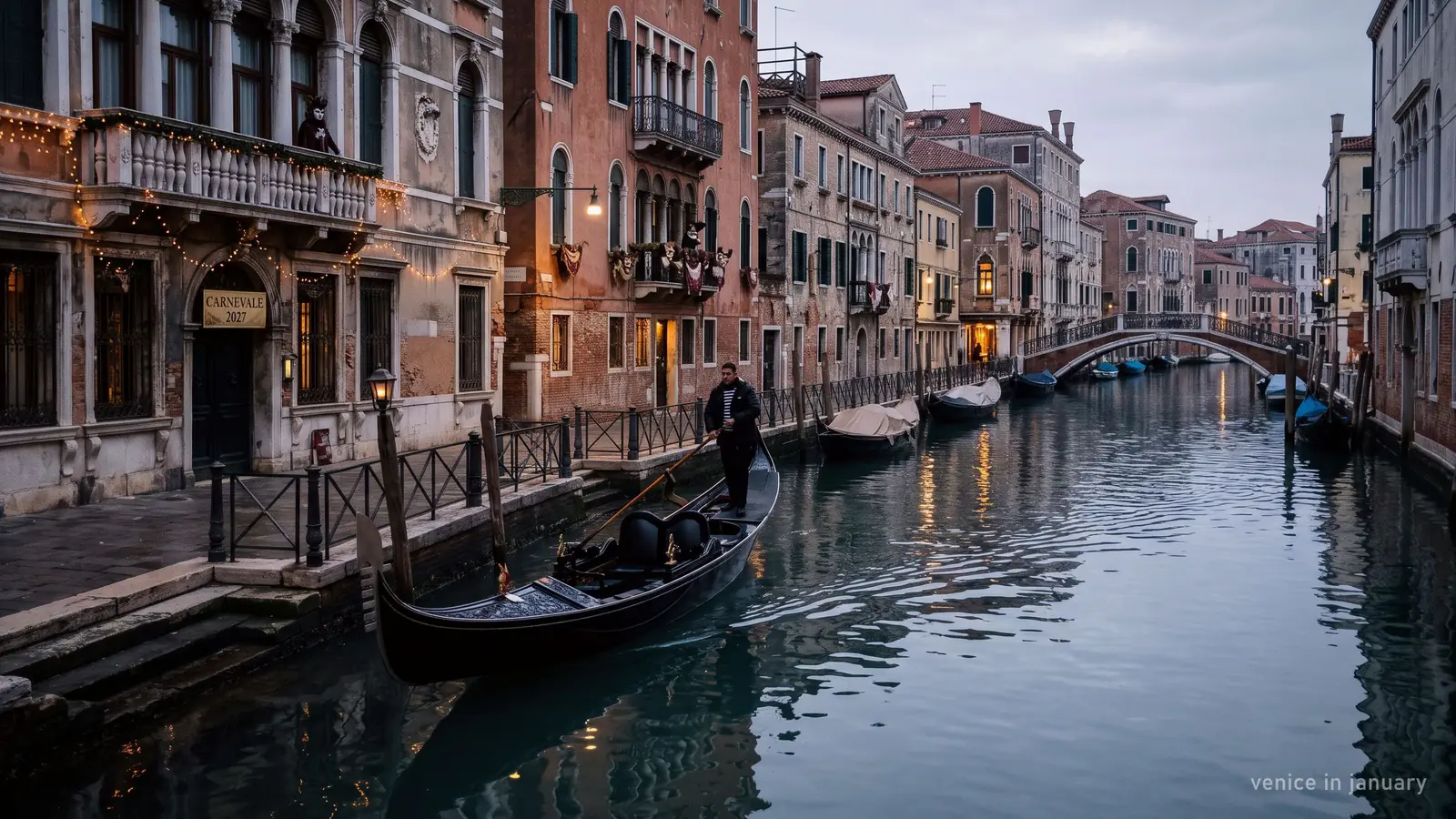
Venice in January is cold and dark early: the average high is 6.7°C, the average low 1.4°C, and the sun sets around 16:52. A gondola ride still runs at the city's day fare of €90 for 30 minutes until 19:00, so in January you can take a ride after dark without paying the €110 evening fare. Rain is light (about 67 mm over 5 wet days), the Carnival of Venice opens on 23 January 2027, and acqua alta, most frequent from October to December, can still flood the lowest streets.
January at a glance
Crowds: low- High
- 6.7°C
- Low
- 1.4°C
- Rain
- 67 mm
- Rainy days
- 5
Sunrise 07:46, sunset 16:52 on 15 January (9.1 hours of daylight). The day fare (€90, 30 minutes) applies 09:00-19:00, so about 2 hours of riding after sunset still costs the day fare.
Climate data: Open-Meteo climate normals 1991-2020 (MRI_AGCM3_2_S) for the Grand Canal, via src/data/entity-context.json; daylight computed for 15 January
What is the weather like in Venice in January?
January is the coldest month in Venice. The climate normals for the Grand Canal give an average high of 6.7°C and an average low of 1.4°C. Rain is modest: about 67 mm falls over roughly 5 wet days, which makes January one of the drier months of the year. Wikipedia describes Venice's winters as cool and damp, with average humidity around 81% in January, and notes that snow is not uncommon between late November and early March. Dress for cold, not for rain.
How many daylight hours do you get for a gondola ride in January?
On 15 January the sun rises at 07:46 and sets at 16:52, giving about 9.1 hours of daylight. The official day fare of €90 for a 30-minute ride runs from 09:00 to 19:00, and the evening fare of €110 for 35 minutes starts at 19:00. That leaves about 7 hours and 50 minutes of daylight riding at the day fare, then about two hours of darkness that still costs €90. If you want lamplit canals, January is the cheapest month to see them from a gondola. If you want photos in daylight, book before about 15:30. The fare is per boat, not per person, as set out on the gondola price page.
Venice Carnival 2027: does it start in January?
Yes. The official Carnival website gives the 2027 dates as 23 January to 9 February 2027. That puts the first weekends of Venice Carnival in late January. Wikipedia puts Carnival attendance at up to 3 million visitors a year, so the second half of the month is livelier than the first. The first half of January has two national holidays: New Year's Day on 1 January and Epiphany on 6 January.
Is there acqua alta in Venice in January?
It can happen. The city's tide centre, the Centro Previsioni e Segnalazioni Maree, records most high tides in November, then December and October; about 70% of events of +110 cm or more fall in those three months. January has fewer, but it is still inside the cold-season window. A tide above +80 cm counts as acqua alta and first floods the lowest point, Piazza San Marco. Events happen mostly in the morning. Several rides listed on this site say they may be changed or cancelled in bad weather, and all of them can be cancelled for a full refund up to 24 hours ahead.
Is a gondola ride worth it in Venice in January?
Yes, with the cold as the caveat. You sit still in an open boat for 30 minutes, so the low of 1.4°C matters more than the high. The upside is the after-dark ride at the day fare, which you cannot get from April to September. A shared gondola ride sells single seats if you are one or two people; a private gondola keeps the whole boat for your group.
What to bring in January
- ✓ A warm coat, hat and gloves: you sit still in an open boat for 30 minutes
- ✓ Waterproof shoes or boots for wet pavements and a possible morning acqua alta
- ✓ A small blanket or scarf for an after-dark ride
- ✓ A phone signed up to the city tide centre's free alerts, which warn of tides forecast at +110 cm or more
Daylight and public holidays, month by month
| Month | Sunrise | Sunset | Daylight | Public holidays 2026 |
|---|---|---|---|---|
| January | 07:46 | 16:52 | 9.1 h | New Year's Day (1), Epiphany (6) |
| February | 07:13 | 17:36 | 10.4 h | — |
| March | 06:24 | 18:15 | 11.9 h | — |
| April | 06:25 | 19:55 | 13.5 h | Easter Sunday (5), Easter Monday (6), Liberation Day (25) |
| May | 05:40 | 20:33 | 14.9 h | International Workers Day (1) |
| June | 05:21 | 21:00 | 15.7 h | Republic Day (2) |
| July | 05:36 | 20:56 | 15.3 h | — |
| August | 06:11 | 20:19 | 14.1 h | Assumption Day (15) |
| September | 06:48 | 19:23 | 12.6 h | — |
| October | 07:26 | 18:26 | 11 h | St. Francis of Assisi's Day (4) |
| November | 07:09 | 16:41 | 9.5 h | All Saints Day (1) |
| December | 07:43 | 16:27 | 8.7 h | Immaculate Conception (8), Christmas Day (25), St. Stephen's Day (26) |
Sunrise and sunset on the 15th of each month at 45.442, 12.326 (Europe/Rome), sea-level horizon. Computed, not observed; within a few minutes. Holidays: national public holidays (IT) from Nager.Date; banks and some attractions may close or run holiday hours.
Venice Gondola in January
Crowds: low- High
- 6.7°C
- Low
- 1.4°C
- Rain
- 67 mm
- Rainy days
- 5
Quiet: the easiest month to visit.
Climate: Open-Meteo climate normals 1991–2020 (MRI_AGCM3_2_S)
Frequently asked questions
How cold is Venice in January?
The 1991-2020 normals give an average high of 6.7°C and an average low of 1.4°C, the coldest of the year.
When does it get dark in Venice in January?
Around 16:52 in mid-January. The sun rises at about 07:46, so you get about 9.1 hours of daylight.
Is a gondola ride cheaper after dark in January?
Not cheaper, but not dearer either. The €90 day fare applies until 19:00 and the sun sets around 16:52, so a ride between sunset and 19:00 is a night ride at the day fare. From 19:00 the evening fare is €110 for 35 minutes.
When is Carnival in Venice in 2027?
The official Carnival website lists 23 January to 9 February 2027.
Does it snow in Venice in January?
Sometimes. Wikipedia notes that snow is not uncommon between late November and early March, though January's 1.4°C average low means most days stay above freezing.
Sources